PLANNING KNOWLEDGE
Destination Wedding Photography in Italy: Why Composition, Architecture and Light Still Matter
Social media is changing how weddings are photographed. Discover why composition, architecture, lighting and curation still matter for destination weddings in Italy.
The Illusion of the Feed: Why Modern Wedding Photography Is Forgetting the Architecture of Memory
A multi-day wedding staged within a historic Italian villa does not unfold inside a six-inch rectangle.
It lives within the soaring vaults of neoclassical porticos, along the dramatic vanishing lines of a sixty-metre imperial table, in the deliberate rhythm of architectural shadows, and across the unchoreographed movement of eighty guests conversing beneath centuries-old Tuscan stone.
Yet something curious is happening to contemporary wedding photography.
As a wedding planner orchestrating complex destination weddings across Italy, I spend months considering how architecture, floral design, lighting, tablescapes and guest experience will coexist within a space. Increasingly, however, wedding imagery is also being created for a very different environment: the vertical screen.
Instagram, TikTok and mobile-first visual culture have inevitably influenced the way images are consumed—and, in some cases, the way they are composed.
There is nothing inherently wrong with that evolution. A vertical portrait can be magnificent. Direct flash can be expressive. Motion blur can inject energy into a dance floor.
The problem begins when a visual trend stops being one instrument in the photographer's vocabulary and becomes the entire language.
For couples investing in a destination wedding in Italy—particularly one built around an extraordinary historic venue—the question is therefore worth asking:
Will your wedding photography document only how the celebration looked on a screen, or will it preserve how the celebration actually felt within the space?
The 9:16 Crop: When an Italian Wedding Venue Disappears
Traditionally, a wedding gallery has moved freely between horizontal and vertical compositions.
Vertical frames have an obvious and important place: bridal portraits, fashion details, architectural doorways, full-length silhouettes and moments where the geometry naturally demands portrait orientation.
The issue is not vertical photography itself.
It is the dominance of vertical photography when the story requires space.
Social platforms have normalised the 9:16 frame. It fills a smartphone screen beautifully and translates immediately into Stories, Reels and short-form content.
But a wedding gallery is not simply a social media campaign.
It is also an archive.
When an outdoor wedding dinner framed by a Renaissance villa, a Tuscan landscape or a monumental courtyard is photographed almost exclusively through tight vertical compositions, much of the environmental story can disappear.
The couple remains.
The dress remains.
The flowers remain.
But the relationship between those elements—and the architecture created around them—is weakened.
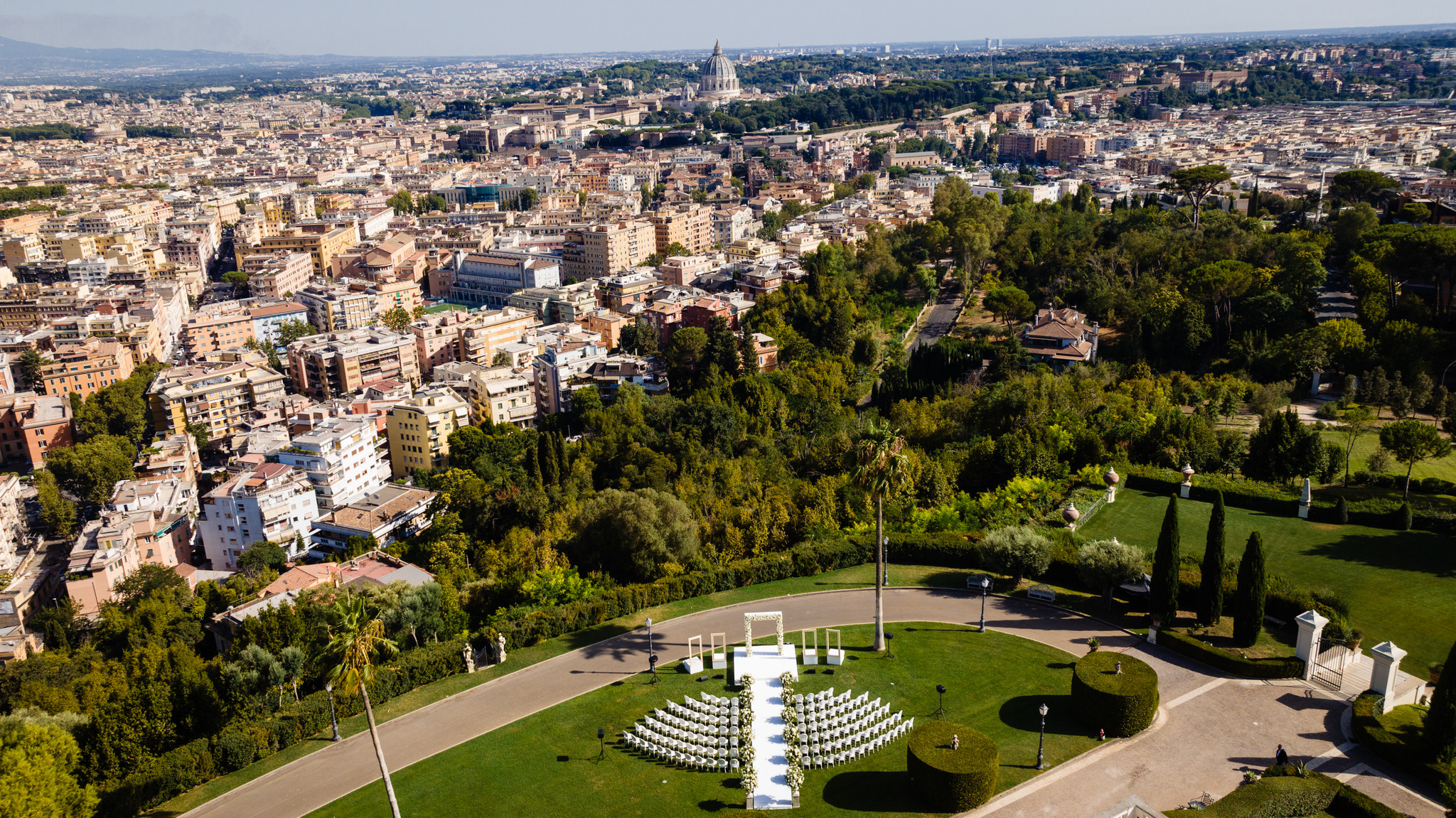
For a destination wedding in Tuscany, Lake Como, Rome or elsewhere in Italy, that relationship matters enormously. The venue is rarely incidental. Couples often choose Italy precisely because they want the landscape, history and architecture to become part of their wedding experience.
Photography should be capable of remembering that too.
Why a Wedding Gallery Needs to Breathe
At Dolce Promessa, we believe a sophisticated wedding gallery should contain a strong foundation of horizontal environmental storytelling, balanced with deliberate vertical compositions.
Not because there is a mathematical rule that determines good photography, but because different orientations perform different narrative functions.
For an architectural destination wedding, horizontal imagery performs three particularly important ones.
1. Context and a Sense of Place
The horizontal frame answers one of the fundamental questions of visual storytelling:
Where are we?
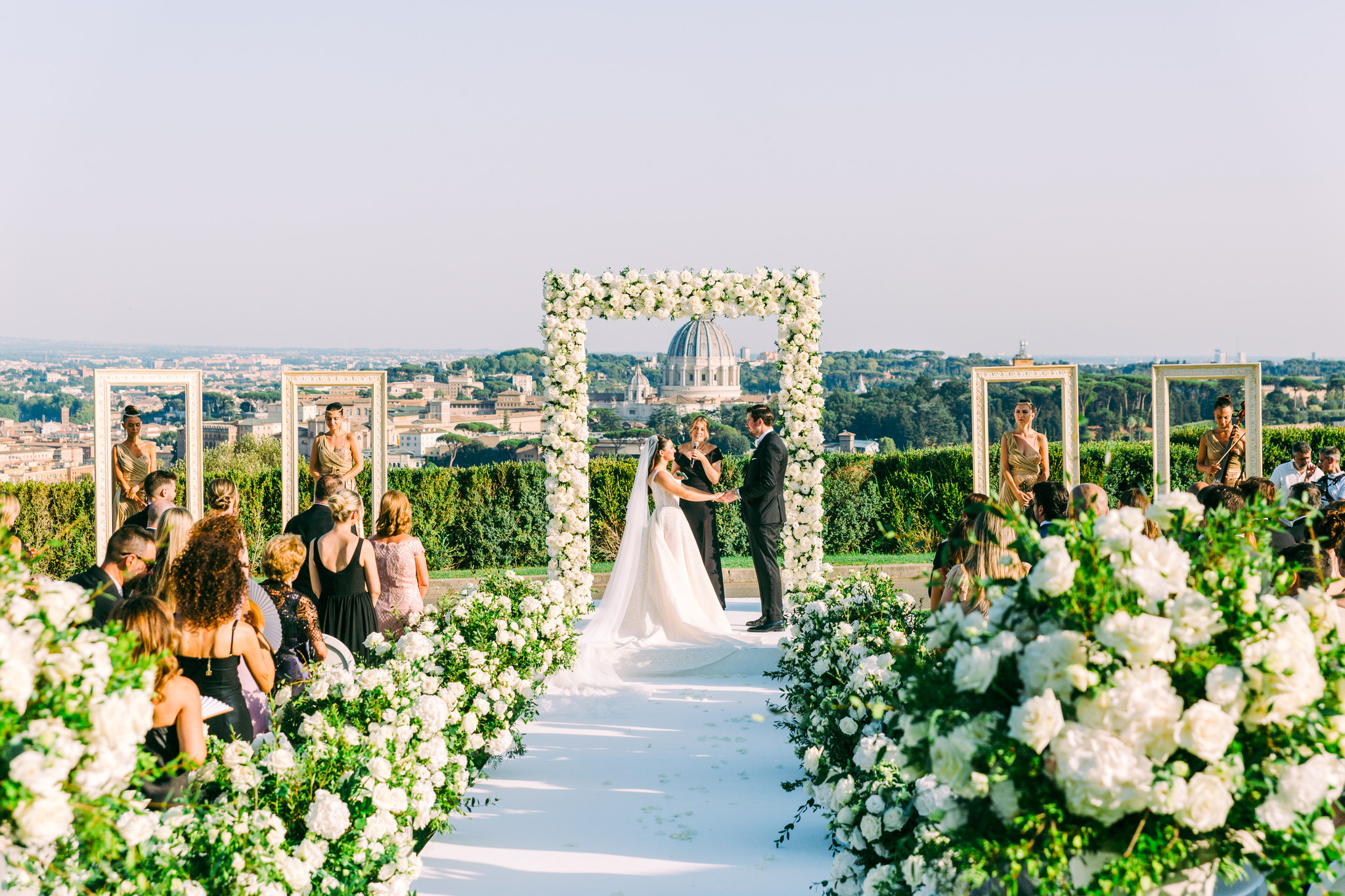
It allows a historic Italian villa, terraced olive groves, formal gardens or a lake horizon to coexist with the couple.
Architecture stops functioning as decorative background and becomes part of the story.
This is particularly important in destination wedding photography because the destination itself is part of what the couple has chosen.
A wedding at a Tuscan estate should not look interchangeable with a wedding anywhere else in the world.
2. Multi-Layered Storytelling
A wedding is not a solitary fashion campaign.
Some of its most powerful moments happen simultaneously.
A bride may be moving through one side of the frame while her father reacts quietly behind her and guests laugh somewhere in the distance.
A wider composition gives a photographer room to connect these independent moments.
Instead of isolating a subject, it can reveal relationships.
That is the difference between documenting a person and documenting a living scene.
3. The Physical Reality of the Wedding Album
There is another consideration that receives surprisingly little attention in the age of Instagram: photographs eventually leave the phone.
A large-format Fine Art wedding album depends on visual rhythm.
Horizontal photographs and environmental frames allow designers to create expansive double-page spreads. Vertical photographs provide contrast, portraits and details.
A gallery overwhelmingly dominated by one orientation can make album design repetitive and fragmented.
The strongest archive gives the designer—and ultimately the couple—both.
Beyond Bullseye Framing: The Lost Tension of Composition
Classical photographic composition draws much of its visual power from tension.
Leading lines.
Negative space.
Layering.
Symmetry and deliberate asymmetry.
The rule of thirds.
The relationship between light and visual weight.
Centre composition can, of course, be extraordinarily powerful. Symmetrical architecture often demands it.
But when every subject occupies precisely the same central position, photographed wide open while the environment dissolves completely into blur, an extraordinary venue can become little more than colour behind a face.
True editorial composition has a broader vocabulary.
It can position the couple against negative space to honour the direction of their gaze. It can use a monumental staircase as a leading diagonal. It can allow a cypress avenue, colonnade or Renaissance facade to establish scale.
Most importantly, it decides composition according to the story of the frame rather than according to the dimensions of a social platform.
Direct Flash, Motion Blur and the Difference Between Style and Dependency
Few wedding photography aesthetics have spread as rapidly in recent seasons as direct flash, dragged shutter and intentional motion blur.
Used deliberately, these techniques can be superb.
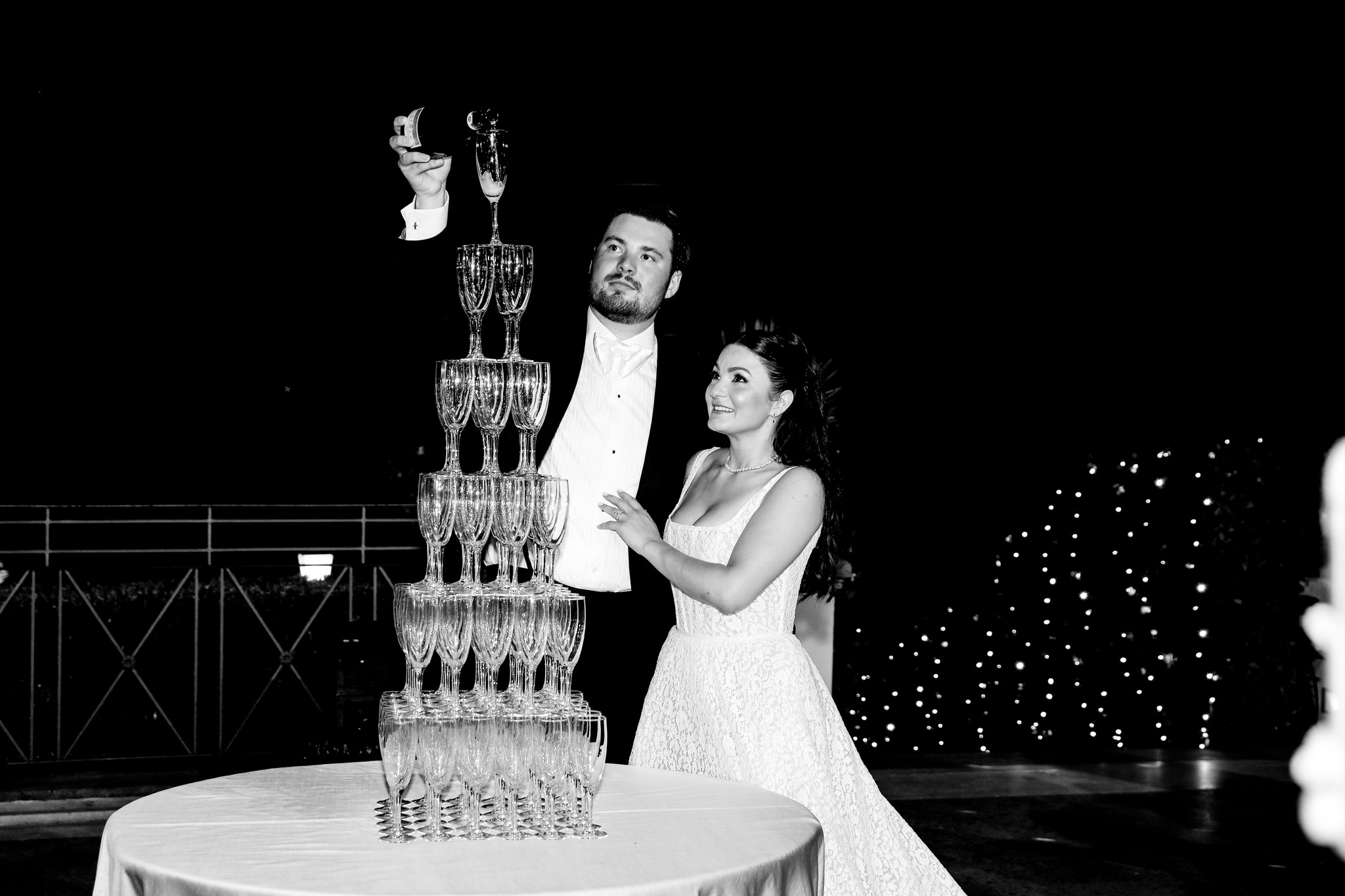
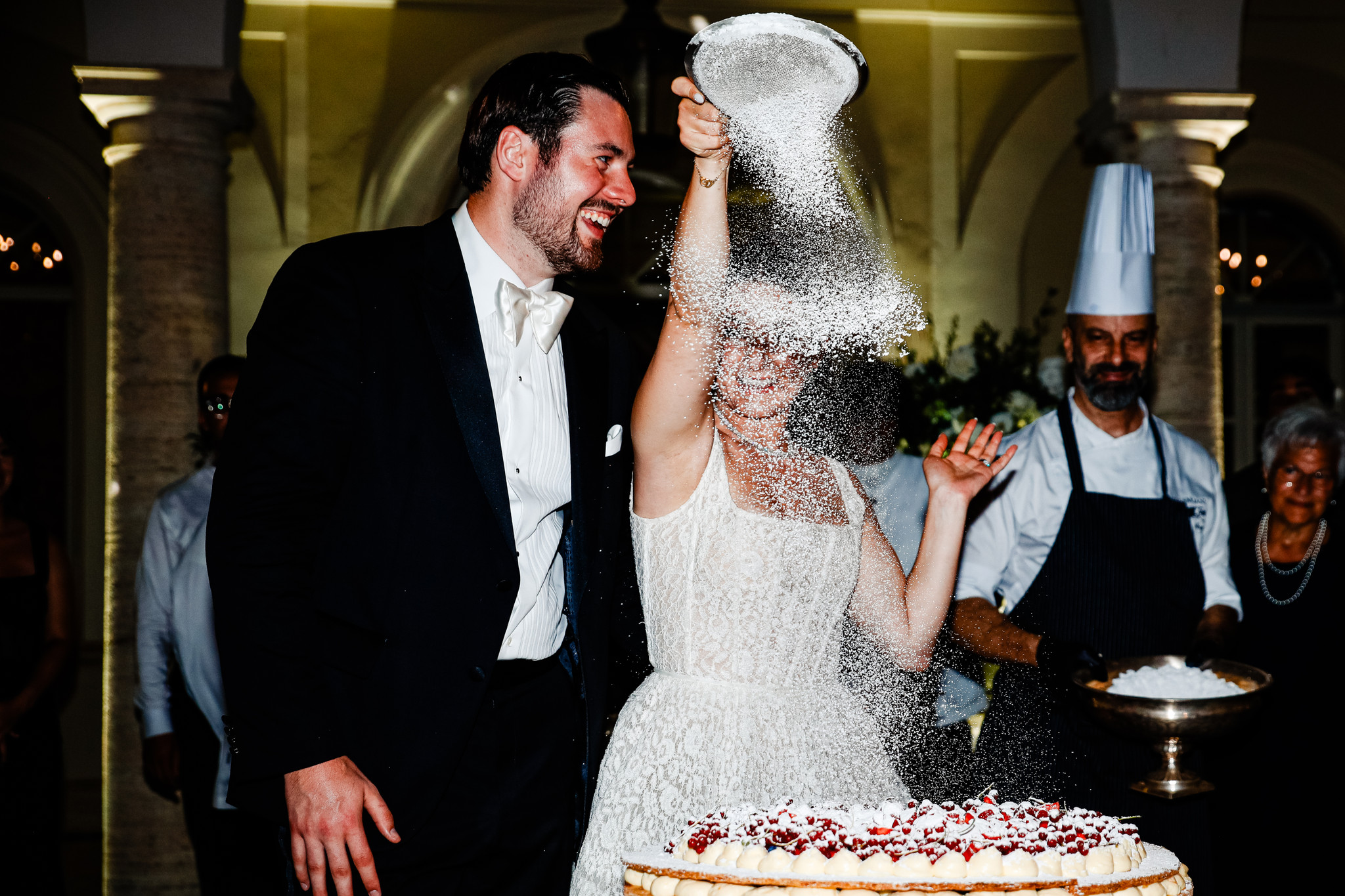
A flash-lit frame on the dance floor can feel spontaneous, glamorous and slightly rebellious. Controlled motion blur can translate movement in a way a perfectly frozen photograph cannot.
We use and appreciate these images as punctuation.
The distinction lies in whether the technique is a creative choice or the only available solution.
At an architectural wedding venue after dusk, photography becomes technically demanding.
The photographer may need to preserve the warmth of candlelight, the illumination of a historic facade, skin tones, glassware, flowers and the movement of the celebration simultaneously.
A direct on-camera flash inevitably changes those relationships.
Used without careful control, it can flatten facial contours, lose delicate detail in pale fabrics and dramatically reduce the visibility of the surrounding environment.
The result can be an illuminated subject floating against darkness—even when the couple has invested considerably in lighting the architecture around them.
An experienced wedding photographer therefore needs more than a fashionable night-time aesthetic.
They need a vocabulary of light.
That may include available light, direct flash, bounced flash, continuous sources, remote off-camera lighting or combinations of several techniques depending on the space and desired result.
The objective is not to eliminate a contemporary aesthetic.
It is to remain in control of it.
Wedding Photography Should Remember the Architecture of Light
This becomes particularly important when planning luxury destination weddings in Italy.
Lighting is not added to a wedding merely so guests can see after sunset.
It is part of the design.
Candles establish intimacy at the table. Architectural illumination reveals the texture and scale of a facade. Pin spots can give flowers dimensionality. Warm ambient light can transform a stone courtyard as daylight disappears.
When photography ignores those layers, part of the wedding design disappears from the visual record.
When photography understands them, something different happens.
The photographer does not simply illuminate the couple.
They preserve the relationship between the couple and the world around them.
That is what we mean by the architecture of light.
The Discipline of the Cull: More Photographs Do Not Necessarily Mean More Memories
There is another consequence of digital abundance: volume can easily be mistaken for value.
Modern cameras can capture extraordinary numbers of frames in seconds. Storage is inexpensive. Digital delivery makes enormous galleries technically simple.
But possibility is not the same as necessity.
A wedding gallery containing 1,500 photographs may be exceptional.
A gallery containing 600 photographs may be exceptional.
The number tells us almost nothing about the quality of the storytelling.
What matters is curation.
Twelve nearly identical photographs of a perfume bottle do not necessarily preserve twelve memories.
Twenty micro-variations of the same makeup moment do not automatically deepen the story.
The photographer's role is not merely to capture.
It is also to recognise.
To identify the frame where gesture, geometry, expression and light finally intersect—and to understand when another image adds something meaningful to the narrative and when it simply repeats what has already been said.
Editing is therefore not the removal of value.
At its best, it is the creation of meaning.
What Should Couples Look for in a Destination Wedding Photographer in Italy?
Couples choosing a photographer for a destination wedding should look beyond the images that perform best on Instagram.
Ask to see complete wedding galleries.
Look at the ceremony, not only the portraits.
Look at dinner after sunset.
Look at family photographs.
Look at the transition between daylight and night.
Look at what happens when one hundred people occupy the same space.
Look at whether the photographer can capture both intimacy and scale.
And, particularly when choosing an extraordinary Italian venue, look at whether you can still understand the architecture of the place after the photographer has finished telling the story.
A portfolio shows what a photographer wants you to see.
A complete gallery shows how they actually see a wedding.
The Architecture of Memory
An exceptional destination wedding is an extraordinary concentration of things that will never exist in precisely the same configuration again.
The people.
The architecture.
The flowers.
The landscape.
The light.
The table before anyone sits down.
The table two hours later, alive with glasses, gestures and conversation.
The quiet immediately before the ceremony.
The chaos immediately after it.
Photography has the privilege—and responsibility—of deciding what survives.
Social media aesthetics will continue to evolve. Some will disappear quickly; others will enter the permanent visual vocabulary of wedding photography.
That evolution should be welcomed.
But it should expand the photographer's language rather than reduce it.
Because fifty years from now, the most valuable photographs may not be those that fitted a six-inch screen perfectly.
They may be the ones that allow two people to open an album and remember not only what they looked like—
but where they were, who surrounded them, how the light fell, and what the world they created together actually felt like.